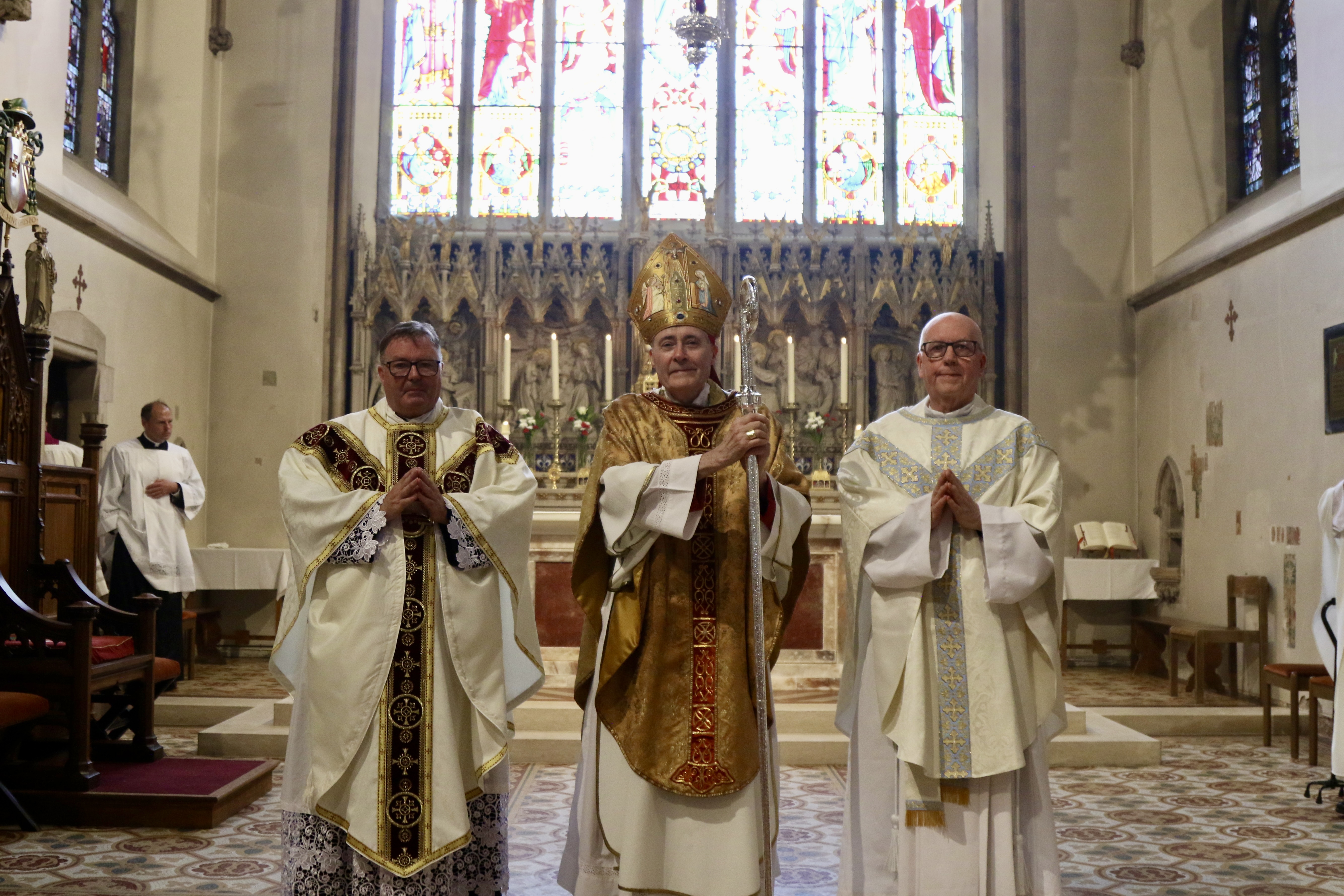
Catholic marriage is a covenant raised to the dignity of a sacrament. The Diocese of Shrewsbury supports couples through Betrothed, the annual Diocesan Marriage Mass, and ongoing formation for engaged and married couples.
One of the great vocations of the Church
Christian marriage is a covenant between a baptised man and a baptised woman, raised by Christ to the dignity of a sacrament, and far more than a contract between two people who happen to be Catholic. The Catechism teaches that "the matrimonial covenant, by which a man and a woman establish between themselves a partnership of the whole of life, is by its nature ordered toward the good of the spouses and the procreation and education of offspring; this covenant between baptised persons has been raised by Christ the Lord to the dignity of a sacrament" (CCC 1601). It is one of the seven sacraments, and it builds the Church.
At a Catholic wedding the bride and groom are themselves the ministers of the sacrament. The priest or deacon witnesses, the Church receives them, and Christ binds what they have given. The Catechism is precise at 1638: from a valid marriage arises a bond between the spouses which by its very nature is perpetual and exclusive. The vows are a real and lasting work of grace.
In his Pastoral Letter for the World Day of Prayer for Vocations on Good Shepherd Sunday, 26 April 2026, Bishop Davies named Christian marriage first among the vocations he placed before the diocese.
"Today, I want to join Pope Leo in inviting all considering their calling to take these steps to discover their vocation, whether this will be found in Christian Marriage; the Consecrated Life of Sisters or Brothers; the Catholic Priesthood; the service of the Diaconate; or the greatness of the lay vocation lived in the midst of the world."
The future of the Church in this diocese depends in real part on Catholic marriages that take the sacrament seriously and live it in front of their children, their parishes, and their neighbourhoods.
Three properties of sacramental marriage
The Church teaches three things about Christian marriage that are worth saying plainly.
- Faithful and exclusive unity. Marriage is the total and exclusive gift of self between this man and this woman. It admits no rival and no division. The two become one flesh (Genesis 2:24; Ephesians 5:31).
- Indissolubility. What God joins, no human authority dissolves (Matthew 19:6). The bond is lifelong. This is not a burden imposed from outside but the inner logic of the total self-gift: you cannot give yourself wholly if you reserve the right to take yourself back.
- Openness to children. The conjugal love of husband and wife is by its nature ordered to the generation and education of new life. Children are the supreme gift of marriage and contribute greatly to the good of the parents themselves (CCC 1652).
These are the shape of the sacrament itself, not heroic ideals layered onto an ordinary contract. Without them there is no Christian marriage. With them, two ordinary people become a sign of Christ's love for the Church (Ephesians 5:31-32).
Marriage preparation in the diocese
The Diocese of Shrewsbury runs an active marriage preparation programme called Betrothed. The most recent residential ran in Chester from 20 to 27 June 2026. Couples preparing for marriage attend either Betrothed or an equivalent programme approved by their parish priest.
Betrothed and the parish-based programmes cover the same ground:
- The theology of marriage as covenant and sacrament.
- Communication and conflict: practical habits for a shared life.
- Sexuality, chastity, and natural family planning.
- Finance and shared decision-making.
- Faith in the home: prayer, Mass, the liturgical year, raising children in the faith.
- The sacrament itself: what the rite means and how to prepare the liturgy.
The aim is to give couples the language and habits of Christian marriage before the wedding day, so that the sacrament is met ready rather than by accident. Most couples who walk this preparation carefully report that the months before the wedding were as formative as the wedding day itself.
Marriage and family life support
The diocese supports engaged and married couples through its marriage formation programmes. The contact for this is listed below.
This work runs formation, supports parishes, and stands behind the diocesan programmes for engaged and married couples. If your parish priest has not yet pointed you toward it, the contact below is glad to hear from you directly. If you are engaged, recently married, or simply trying to live the sacrament more deeply, this support is for you.
How to plan a Catholic wedding: the practical steps
If you are planning to marry in the Catholic Church in this diocese, the practical pattern is well established.
- Speak to your parish priest at least six months before your proposed wedding date. Earlier is better, particularly if either of you has a previous marriage that needs to be examined by the Marriage Tribunal.
- Begin marriage preparation. Your parish priest will advise which programme is available. Ask about Betrothed or the parish-based equivalent.
- Complete the prenuptial enquiry. This takes place with the parish priest. You will gather baptism certificates and confirm your freedom to marry.
- Arrange civil notice with the registrar. A Catholic wedding in a licensed church counts as a civil marriage, but notice must be given to the local register office. Allow enough time.
- Plan the liturgy with your priest or deacon. Choose your readings (there are several options set by the Rite of Marriage). Sit with the vows. Decide on music.
- Attend the rehearsal, ideally in the church itself, so that the rite is familiar before the day.
The annual Marriage Mass
Each year the Diocese gathers married couples, particularly those celebrating significant anniversaries, to a Thanksgiving Mass presided over by Bishop Mark. These Masses have been celebrated in the Diocesan Cathedral and historically also at St Columba's, Chester. Vows are renewed and grace is given for the next chapter.
Marriage and the wider Church
Marriage is not a lesser vocation than the priesthood or consecrated life. The 12 men currently in priestly formation in Shrewsbury Diocese serve the whole Church, and Christian marriage is a large part of what they serve. Without strong marriages, there are no strong parishes. Without strong parishes, there are no priests, no deacons, no sisters, no children walking to the altar to be confirmed. Each vocation needs the others.
The sacrament gives a particular grace for the demands of married life: patience when patience runs out, forgiveness when memory wants to keep score, generosity to children, to the in-laws, to the parish and the wider world. The grace is given, and the grace is for use.
If you are already married
This article is for engaged couples and for those discerning marriage as a vocation, but it is also for the marriages already in this diocese. The sacrament is not just received on the day; it is lived through every year that follows. The Diocese supports spouses through marriage formation, parish events, the annual Mass, and the wider network of Catholic marriage support. If your marriage is in difficulty, your parish priest is the first door, and the diocese is the second.
Your next step
Three concrete things you can do.
- If you are engaged, speak to your parish priest this week and ask to begin the preparation process. Then use the contact listed below to ask which formation programmes are running this season.
- If you are already married, mark the next diocesan Marriage Mass in your diary and bring your spouse.
- If you are single and wondering whether marriage is your vocation, read Tobit chapter 8, the prayer of Tobias and Sarah on their wedding night, and ask the Lord to lead you.
Marriage is a calling, not a lottery. The Lord knows the husband or wife he has in mind for you, and he wants you to be holy together.
Key Contacts