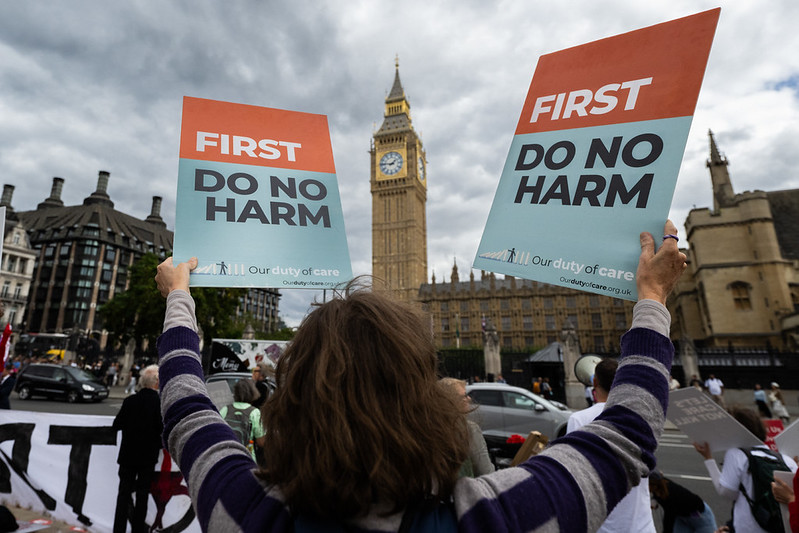

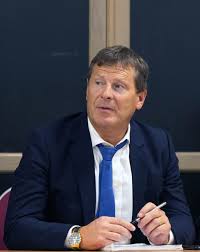
The Bishop of Shrewsbury has welcomed the defeat of yet another Bill to legalise assisted suicide in England and Wales.
The Rt Rev. Mark Davies said he wished to record his thanks to all the MPs who “decisively rejected” the Terminally Ill Adults (End of Life) Bill and “the seismic change it threatened to bring to our society by fostering a culture of medically assisted suicide”.
Bishop Davies said: “The end of this assisted suicide Bill must lead us to strengthen palliative care in truly assisting and caring for some of the most vulnerable members of society.”
The Bishop spoke after MPs threw out the Private Member’s Bill of Lauren Edwards, the Labour MP for Rochester and Strood, Kent, at Second Reading in the House of Commons on Friday.
The Bill was rejected by 286 votes to 270, a majority of just 16.
Andy Burnham, the Prime Minister and a Catholic, abstained but Conservative leader Kemi Badenoch, Reform UK’s Nigel Farage and Liberal Democrat leader Sir Ed Davey all voted against the Bill.
It was the fifth time in 12 years that pro-assisted suicide politicians have attempted to use a Bill to remove legal prohibitions against assisted suicide, a crime which under the 1961 Suicide Act can be punished by up to 14 years in prison. Three Bills have been tabled in the Commons and two in the Lords since 2014.
The Edwards Bill would have allowed terminally ill adults deemed to have few than six months to live to obtain lethal drugs to commit suicide with the assistance of medics.
It was identical to the first draft of the Bill introduced into the Commons in 2024 by Kim Leadbeater, the Labour MP for Batley and Spen, but which in 2025 ran out of parliamentary time in the House of Lords.
The Leadbeater Bill fell in the face of some 1,200 amendments tabled by peers gravely concerned about inadequate protections and other flaws, even though 77 conciliatory amendments were accepted by the Bill’s sponsors, none of which were retained by Edwards.
During the summer, Bishop Davies urged the Catholics of the Diocese to do their utmost to persuade their MPs to vote against the draft legislation.
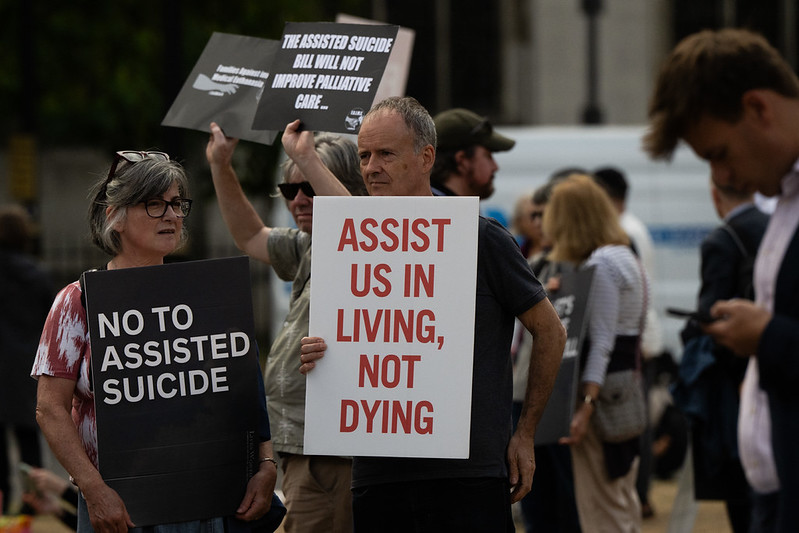
“The euthanasia lobby will not easily give up its efforts to breach long-established protections in our laws, and we must be as resolute and tireless in our own stand for the value of every human life and the protection of those most vulnerable,” Bishop Davies said in a message at the time.
“As Christians we oppose medical killing in principle. The sanctity of human life is one of the great gifts which Christianity brought to human civilisation.”
The defeat of the Bill was also welcomed on Friday by the Most Rev. John Sherrington, Archbishop of Liverpool and the Lead Bishop for Life Issues for the Bishops’ Conference of England and Wales.
“I would like to express my gratitude to those MPs who voted against the Bill and the many people from across society who made their voices heard – doctors, legal professionals, disability groups, other faith communities and those of no faith who stood up for the dignity and sanctity of every life,” Archbishop Sherrington said.
“Throughout this debate, we have argued that our response to those facing serious illness, disability or the challenges of old age should be rooted in solidarity, care and respect,” said Archbishop Sherrington.
“The true measure of a compassionate society is its willingness to support people through difficult circumstances rather than encouraging them to end their lives.”
He said: “We remain convinced that the most effective way to address suffering at the end of life is through greater access to excellent palliative and end-of-life care. Ensuring such care is available to all who need it can help people experience comfort, dignity and support in their final days. We will continue to promote these as priorities and to stand alongside those who devote themselves to caring for the dying in hospices, hospitals, care homes and communities.”
The archbishop said that he hoped “all the sick and frail find comfort in the support of their loved ones, and the love of God, which transcends all suffering”, adding: “I ask the Catholic community to continue to pray for our legislators, that they will ensure that our laws always uphold the dignity of human life.”
The Bill was opposed by the Royal College of Psychiatrists, the Royal College of General Practitioners, the Royal College of Physicians, the Royal College of Nursing, the Royal College of Pathologists, the Royal Pharmaceutical Society, the Equality and Human Rights Commission, the British Association of Social Workers, the British Geriatrics Society, Hospice UK, the Association for Palliative Medicine and scores of disability rights and mental health groups.
.jpg)
Among those MPs to speak in the debate was Ashley Dalton, Labour MP for West Lancashire, who is terminally ill with stage four incurable metastatic breast cancer and who pleaded with fellow legislators to either abstain or vote against the legislation.
Ms Dalton, a Catholic, said: “In the campaign around this Bill, though, it seems to me that it is being implied that a person with a terminal illness will have a dreadful, painful death unless they have access to assisted dying. That is simply not true; palliative care in the UK is excellent.
“Far too many people do not have access to the palliative care they need, but the idea that it is not possible to alleviate pain and discomfort is false. People have been terrorised — I have been terrorised — with tales of people vomiting up their own faeces, as though this is commonplace during death. It is vanishingly rare.
“Bowel obstructions are more common, but they are treatable. I know — I have had one. It is nothing short of irresponsible to scaremonger people like me into believing our deaths will be horrific when all the evidence suggests that, with access to good palliative care, deaths are, on the whole, gentle.”
Alisdair Hungerford-Morgan of Right to Life UK described the vote as “a remarkable victory for the most vulnerable in our society”.
“They deserve protection and care, not a pathway to suicide,” he said.
The rejection of the Bill by Westminster comes just months after the Scottish Assembly threw out similar draft legislation to permit the practice.
© Mazur/cbcew.org.uk